


Recognising ancient woodland indicator plants in spring
Certain plants thrive only in long-established woods. Learn to recognise indicators such as wood anemone, dog's mercury, and wild service tree.

Why some plants tell you a wood is old
In Britain we call a wood "ancient" if it has been continuously wooded since at least 1600 in England and Wales, or 1750 in Scotland. That cut-off is not arbitrary. It marks the point at which mapping and record-keeping became reliable, so an unbroken history of tree cover can be traced with reasonable confidence. The practical consequence for anyone walking a wood in spring is that the ground flora changes character. Plants that colonise quickly by wind-blown seed are everywhere, but a handful of species travel at a glacial pace — a metre or two a century by creeping rhizomes, or a few dozen metres per generation by seed. Find them in quantity and you are standing on continuity rather than coincidence.
Wood anemone and the arithmetic of a slow colony
Wood anemone is the most reliable and best-loved of the spring indicators. The flowers appear from March into May, before the canopy closes, and each bloom carries six or seven white petal-like sepals, often washed with pink on the underside. Look closely at the leaves: they are deeply divided, almost feathery, and grow in loose whorls rather than flat rosettes. The plant spreads chiefly by rhizome, so a patch is usually a single clone expanding outward at walking pace — which is to say, barely at all. Pacing out a carpet thirty metres across is a sobering exercise. It implies centuries of undisturbed soil.
Timing matters. Anemones close their flowers at night, in rain, and in dull weather, so a grey afternoon can leave you staring at a wood that looks empty. Visit between late morning and mid-afternoon on a bright day. They also dislike heavy grazing, drainage and nutrient enrichment, so their abundance is itself a comment on how the wood has been treated.
Dog's mercury and the other carpet-formers
Dog's mercury is less glamorous but equally telling. It pushes up in February and March, before the trees leaf out, as a dull green carpet of opposite pairs of toothed leaves. The flowers are small and greenish, borne on separate male and female plants, and easy to overlook entirely. Where it forms dense sheets, the ground has rarely been ploughed, planted or fed. It spreads by rhizome too, and it fades back once shaded.
Several other species behave in the same slow, tell-tale way. Learn a few and you can assess a wood in half an hour:
- Wood sorrel — trefoil leaves that fold at dusk, white veined flowers, fond of acid soils.
- Ramsons (wild garlic) — unmistakable garlic scent, broad leaves, white star flowers in April.
- Yellow archangel — yellow dead-nettle flowers, often on the woodbank edges and older rides.
- Woodruff — whorls of narrow leaves with a scent of new-mown hay when dried.
- Herb Paris — a single four-petalled green flower above four leaves; scarce but decisive.
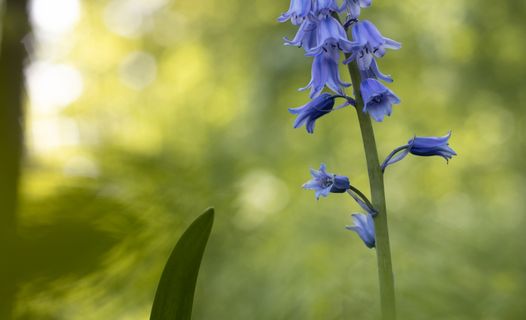
- Native bluebell — nodding, one-sided flower spikes, cream anthers and a sweet scent, quite unlike the stiff, upright garden escapes.
- Early purple orchid — spotted leaves and purple flowers from April, a strong sign of unimproved ground.
The trees and shrubs that betray an old boundary
It is not only the ground layer. The wild service tree is the classic woody indicator, and in much of southern and central England it is found almost exclusively in ancient woods and old hedgerows. Its leaves look maple-like at a glance, but the lobes are untoothed, the bark breaks into grey-brown squares like a cherry, and the white blossom comes in May. In autumn it carries speckled brown berries traditionally called chequers, once used to flavour ale. Other woody giveaways include small-leaved lime, midland hawthorn and wild pear, all of which suggest a wood that has looked after itself for a very long time.
Look also at the structure beneath the trees. Old coppice stools several feet across, boundary banks and ditches, and lines of pollarded trees all point the same way as the flora, and they are often easier to date from estate maps and tithe records.
Reading the whole wood, not just the list
A word of caution: indicator species are evidence, not proof. Their absence from a genuinely old wood is common, because grazing, drainage or conifer planting can wipe out a ground flora in a couple of decades. Equally, plants can be introduced on dumped garden waste or in soil moved during road building. What you want is a preponderance of evidence.
Negative indicators are just as useful. Dense bramble, swathes of bracken, nettles and cleavers, sycamore saplings, rhododendron and laurel all suggest disturbance, enrichment or recent planting. A wood that is uniformly dark under a maturing conifer crop tells you very little about its past until the canopy is opened up again.
Recording what you find, and looking after it
If you own or manage a few acres, or simply walk the same wood each spring, keep notes. Take a grid reference for each good colony, count patches rather than individual plants, and photograph leaves as well as flowers. Pass records to your county records centre or a local recording group; they feed into the wider picture of where our oldest woods survive. Then, on the ground, do the simple things well. Avoid tipping garden waste or hedge cuttings into the wood, keep stock and deer pressure light enough that the ground flora can flower and seed, remove invasive species early, and coppice in rotation rather than thinning heavily over your best anemone patches. Spring is short — walk it often, and let the plants do the talking.
Post a comment