


Planning a woodland wildflower meadow for pollinators
A woodland meadow can feed pollinators and brighten clearings. Plan seed mixes, ground preparation, and mowing regimes suited to shaded conditions.

Start with the edge, not the middle
A woodland wildflower meadow rarely works as a rectangle cut into deep shade. The best results come from working with the gradients of light that already exist: along ride edges, under a scalloped woodbank, in a clearing where a tree has blown over, or in the strip where canopy meets hedge. These transition zones — sometimes called woodland edge habitat — catch several hours of direct sun while keeping the humidity and leaf litter that woodland plants need. In practice, aim for a site that receives at least four hours of sun on a bright June day, ideally from the south or west.
Small is fine. A twenty-metre strip along a ride can support more pollinators than a patchy half-acre in gloom, and it is far easier to manage with hand tools.
Read the light, then pick your mix
Shade is not a single condition. Dappled light under ash or birch changes through the day; the north side of a dense beech stand is a different world entirely. Walk the site at three points in the day before you commit to seed.
- Full sun, six hours or more: classic meadow species will thrive — knapweed, field scabious, ox-eye daisy, bird's-foot trefoil, selfheal and meadow buttercup.
- Dappled or half shade, three to five hours: the richest group for pollinators in woodland settings. Red campion, hedge woundwort, wood avens, betony, greater stitchwort, foxglove, wild strawberry and wood cranesbill all earn their place.
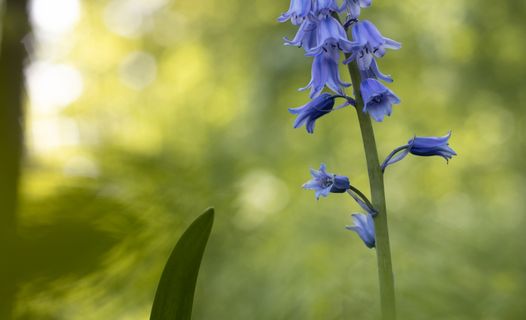
- Deep shade: accept ground cover rather than flowers. Native bluebell, wood anemone, wood sedge and ferns will do more for the wood than a struggling wildflower mix.
For grasses, favour wood meadow-grass, wood false-brome, sweet vernal grass and tufted hairgrass. Avoid agricultural ryegrass and cocksfoot: they out-compete everything and smother the flowers you actually want.
Ground preparation makes or breaks it
Most failed woodland sowings are really ground preparation failures in disguise. Seed needs to touch soil, and woodland soil is usually blanketed in leaf litter, bracken or bramble.
- Clear bramble, bracken and ivy by hand or with a brushcutter, then dig out the roots of the worst offenders. Do this in late summer or early autumn when sap is going down.
- Scarify or lightly rake the surface to expose mineral soil. Light disturbance is good; deep ploughing destroys the fungal networks that make a wood work.
- Do not touch existing bluebell, wood anemone or orchid colonies. Work around them and they will spread into your new opening on their own.
- On heavy clay, add a thin layer of coarse grit or well-rotted leafmould to improve seed contact — but never import topsoil, which brings in weed seed and unwanted nutrients.
If the ground is nutrient-rich and nettles or cleavers dominate, you have a fertility problem before you have a planting problem. Cut and remove growth for two seasons to draw nutrients down before sowing.
Sowing and using plugs
British native seed of local provenance is worth the extra cost and the waiting time. Autumn sowing, from September to late October, matches natural seed fall and gives roots a head start before winter. Mix seed with sand or dry compost to sow thinly and evenly — around 2 to 4 grams per square metre for a wildflower-rich mix, less if you are adding grasses.
Under shade, seed germination is slower and less reliable. Plug plants are the practical answer for key species: red campion, betony, hedge woundwort and wood avens all establish well from plugs planted in autumn. Space them 30 to 40 centimetres apart in informal drifts rather than rows, and water only in a genuinely dry spell.
A mowing regime suited to shade
The cut is where most woodland meadows go wrong. Too frequent, and you lose the flowers; too rare, and bramble and bracken win.
- Year one: cut twice, in early July and again in late September, taking the cuttings away. This controls annual weeds and reduces fertility.
- Established meadow: a single main cut in late July or August, once seed has set, followed by a tidy-up cut in late autumn if growth is rank.
- Always remove arisings. Leaving cut grass in place feeds the soil and encourages coarse grasses at the expense of flowers.
- Rotate a third of the area each year, leaving some patches uncut over winter. Tussocks, hollow stems and seed heads are winter habitat for invertebrates.
- Mow the first metre of any path or ride edge closely and let the rest grow tall. This gives a soft edge and keeps access easy.
Hand tools — a scythe, a strimmer with a blade, or a small mower on a high setting — suit most woodland plots better than a tractor. Cut on a dry day and let the hay lie for a day or two so seed drops back onto the ground.
Think beyond the flowers
A meadow is only part of the picture. Pollinators need somewhere to nest and overwinter as much as they need nectar. Leave deadwood log piles in dappled shade, keep a patch of bramble on a sunny edge, and let ivy flower in autumn — it is one of the best late-season nectar sources in Britain. A shallow scrape or a damp hollow will draw in solitary bees and hoverflies, and a ragged hedge bottom does more for insects than a neatly trimmed one.
Above all, be patient. A woodland meadow takes three to five years to settle into itself, and its composition will shift as the canopy grows and light levels change. Watch what arrives, cut accordingly, and let the wood decide some of the answers.
Post a comment