


Understanding soil types in British woodlands
Soil affects which trees and plants will flourish. Compare acid, neutral, and alkaline conditions, and learn simple field tests for your woodland plot.

The ground beneath the trees
Walk into any British woodland and you are looking at a long conversation between geology, climate and centuries of leaf fall. Soil is the slow half of that conversation: it decides how much water reaches the roots, which nutrients are available, and how quickly a seedling can get its head above the bracken. Two neighbouring woods on the same hillside can carry entirely different trees because one sits on a band of limestone and the other on sandstone.
If you own or manage a plot, soil is the most useful survey you can carry out — far more useful than a plant list, because it explains the list you already have.
Acid, neutral and alkaline: what the numbers mean
Soil pH runs from about 3.5 in a wet heath to 8.2 over chalk, and most woodland plants sit between 4.5 and 7.5. The scale is logarithmic, so pH 5 is ten times more acidic than pH 6, and a shift of one whole point matters more than it sounds.
- Acid soils (below pH 5.5): formed over sandstone, granite, gritstone, slate or deep peat. Low in calcium and magnesium, with nutrients often locked up in raw organic matter.
- Neutral soils (pH 5.5–7): the middle ground over many clay and loam geologies. Most British broadleaves are happiest here.
- Alkaline soils (above pH 7): chalk and limestone country — the Chilterns, Cotswolds, Yorkshire Wolds and much of the North Downs. Free calcium makes phosphorus and iron harder for plants to take up.
Plants that tell you what the soil is doing
Indicator species are the quickest reading you will get. Look at what is already growing before you dig anything.
- Strongly acid: bilberry, heather, tormentil, wood sorrel, wavy hair-grass and mats of moss.
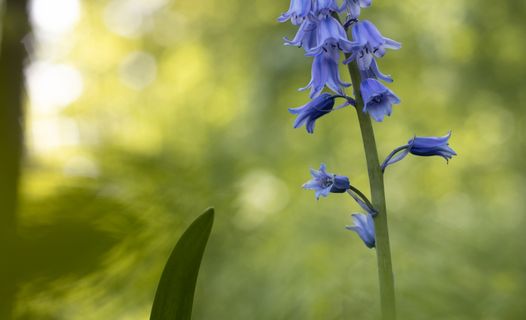
- Neutral to mildly acid: bluebell, dog's mercury, wood anemone, wild garlic and primrose.
- Alkaline: cowslip, salad burnet, wild thyme and traveller's joy, often with a thin, dark humus layer beneath beech or ash.
Bracken, bramble and foxglove grow almost anywhere, so look for three or four species agreeing before you trust the picture.
Field tests you can do this weekend
None of these replace a laboratory analysis, but together they will give you a working picture. Take samples from several points, not just one.
- The vinegar test: put a spoonful of soil in a jar and pour on a little white vinegar. Fizzing means free calcium carbonate — you are on chalk or limestone. No reaction suggests an acid or neutral soil.
- The bicarbonate test: if the vinegar did nothing, add bicarbonate of soda and a splash of water. Bubbles here point to an acid soil.
- The jar test: half-fill a clear jar with soil, top up with water and a drop of washing-up liquid, shake hard, then leave for 24 hours. Sand settles first, silt next, clay last — the proportions give you your texture.
- The ribbon test: roll moist soil between your palms. A long, flexible ribbon means heavy clay; one that crumbles before 25mm means sandy or gravelly ground.
- The drainage pit: dig a hole 30cm deep, fill it, let it drain, then refill. If it empties within an hour, drainage is fast; if it is still full next morning, you have a wet, poorly aerated site.
A cheap probe meter or a few indicator strips will give you a firmer pH figure. Take readings at 10cm and again at 30cm — topsoil and subsoil are often quite different.
Matching trees to the ground
Once you know what you have, choose species already adapted to it. This is cheaper than amendment and far more likely to succeed.
- On acid soils: sessile oak, silver birch, Scots pine, rowan, sweet chestnut and holly, underplanted with bilberry, heather and honeysuckle.
- On neutral soils: pedunculate oak, ash, field maple, wild cherry, hazel, crab apple and small-leaved lime — almost anything in the British broadleaf palette will take.
- On alkaline soils: beech, ash, field maple, yew, whitebeam, dogwood and wayfaring tree. Avoid rhododendron, blueberry and most conifers, which yellow with lime-induced chlorosis within a season or two.
Depth matters as much as chemistry. Chalk soils are often shallow over rock, and trees on them suffer in a dry July however alkaline-loving they are.
Working with what you have
Improving woodland soil is slow work and rarely worth fighting. Compost around newly planted whips helps them establish, and a mulch of leafmould or well-rotted bark will buffer pH slightly over the years. On heavy clay, planting on a slight mound does more for establishment than any fertiliser.
Above all, protect the soil you have. Compaction from machinery and footfall is the commonest damage in small woods and can take a decade to recover. Keep vehicles off wet ground, coppice on rotation rather than clearing in one go, and leave deadwood to rot where it falls — that is next century's topsoil in the making.
Spend an afternoon with a spade, a jar and a strip of indicator paper, and you will know your wood better than most people know their own garden.

Post a comment